



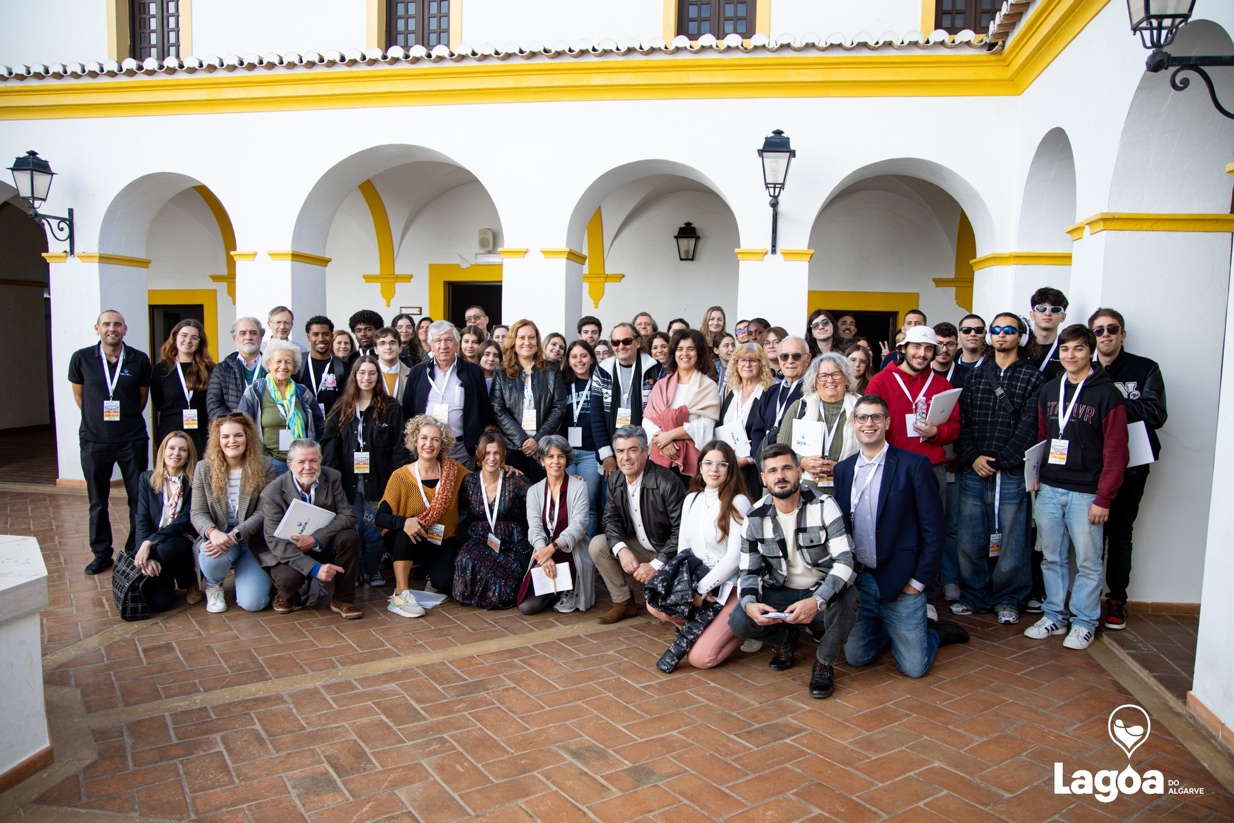
Fig. 1. CONVENTUS team (coordination, research, Municipality of Lagoa, scientific consultants, and local community), speakers, students, and participants at the CONVENTUS Project International Seminar, held on 21–22 November 2024 at the São José Convent Cultural Centre in Lagoa, Portugal. Source: CONVENTUS Project.
The CONVENTUS project presents new inclusive and plural perspectives on the building of the former Convent of São José in Lagoa, Algarve (southern Portugal), applying a diachronic approach to the study of its history, architecture, urban impacts, and social interactions over more than three centuries of existence. This approach is developed through the application of the concept of Participatory Action Research to religious heritage.
With more than three centuries of history, this building—originally founded as a female religious house of the Carmelite Order—later served as a school run by Dominican nuns. After its secularization, it accommodated a wide range of uses, such as a primary school, headquarters of the National Scouting Group, the parish church of Lagoa, the Civil Registry Office, a post of the National Republican Guard, the Lagoa Parish Council, the Municipal Museum of Art, Ethnography and Archaeology, and various municipal services. From 1993 onwards, it assumed the role of a Cultural Centre, a function it continues to perform to this day (Fig. 2).
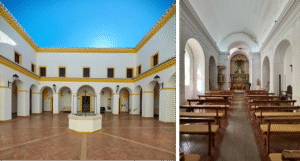
Fig. 2. The former Convent of São José, Lagoa – currently the São José Convent Cultural Centre (general view of the cloister and the church). Source: CONVENTUS Project.
The recent transformations in the functional dynamics of this landmark building in the city of Lagoa have made it necessary to rethink its roles, actively promoting its sociocultural values and its importance within the local community as a driver of integrated and inclusive sociocultural development.
In response to this need, the CONVENTUS project develops an integrated, participatory, and multidisciplinary investigation of the former Convent of São José, with the aim of producing scientific content that will serve as the basis for defining a museological plan of a participatory character, nature, and structure for this religious heritage. At the same time, it organizes a set of activities and products for disseminating the generated knowledge, aimed at the scientific community, the public, and the local community.
In parallel, the project aims to contribute to the development of theoretical and methodological knowledge on long-term diachronic approaches in the study of religious architecture and its historical, cultural, urban, and social interactions, as well as to experiment with, evaluate, and generate knowledge on participatory methodologies and practices in the field of religious heritage management.
To this end, a combination of methodologies is employed, bringing together historical and architectural research on this former conventual space with biographical research, through the active, direct, and regular participation of the local community, enabling a careful and plural approach to its material and immaterial dimensions.
Comprising a multidisciplinary team that brings together different forms of knowledge and experience—bringing together researchers, municipal technical staff, members of the local community, and scientific consultants (Fig. 1)—as a result of a partnership between the Centre for Social Studies – University of Coimbra, the Centre for Research in Archaeology, Arts and Heritage Sciences – UAlg Hub, and the Municipality of Lagoa, the CONVENTUS project is structured around three lines of research.
Line 1 – Discovering the Written and Architectural History focuses on the collection and analysis of data from bibliographic and documentary sources (manuscript, printed, graphic, cartographic, iconographic, and photographic), together with the architectural analysis of the building. Based on an exhaustive literature review, the relevant documentary collections for the research were subsequently identified and consulted in national, regional, and municipal archives.
This process resulted in a vast documentary corpus, which was later systematized in a database, allowing the organization of the collected information according to different chronological periods. These data were cross-referenced with those derived from architectural interpretation, using regressive analysis methods through drawing to identify the building’s construction process and its transformation over time (Fig. 3).
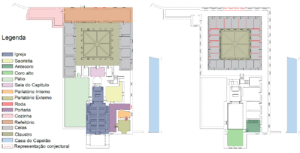
Fig. 3. Ground floor plan and first floor plan of the Convent of São José in the 18th and 19th centuries (with identification of the conventual spaces). Graphic representation of the location of the different conventual spaces produced as a result of the architectural interpretation of the building. Drawing created by Tiago Sobral (CONVENTUS Project).
Line 2 – Discovering Spoken Memories focuses on the collection of historiographical data through biographical research carried out by means of a series of semi-structured interviews with members of the local community, revealing the memories and meanings attributed to the building. Complementing this data collection, two Active Listening Visits (Fig. 4) and four Conversation Circle sessions (Fig. 5) were conducted, focusing on topics considered relevant by the local community.
These tools provided a privileged space for the recovery and sharing of local memories, experiences, and knowledge, enabling participants to reflect collectively on their personal experiences, as well as on processes of social and cultural transformation within the contexts and realities addressed.
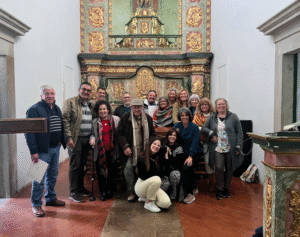
Fig. 4. Participants in the Active Listening Visit to the church of the Convent of São José, held on 15 March 2024 and guided by Carlos Soares (center), visual artist responsible for the restoration of the church between 1985 and 1992. Source: CONVENTUS Project.
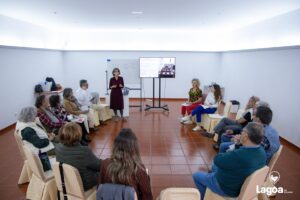
Fig. 5. Conversation Circle 2 – Theme: Memories of the School, an activity facilitated by the CONVENTUS team with the participation of the local community, held on 4 April 2024. Source: CONVENTUS Project.
Line 3 – Sharing Networked Experiences aims to create an active, multifaceted, and multidirectional cultural network, establishing points of contact with other buildings of a similar nature at local, regional, national, and transnational levels, and connecting synergies between the buildings, the institutions responsible for them, and the communities that inhabit them.
This involved mapping former conventual buildings currently in cultural use across the Iberian Peninsula (Fig. 6) and conducting a comparative analysis of the cultural projects underway in each of these properties, thereby establishing the foundations for a theoretical and methodological analysis that will enable a rethinking of the social and cultural role of these buildings and the ways in which they can cooperate by sharing experiences within a broad network of knowledge.
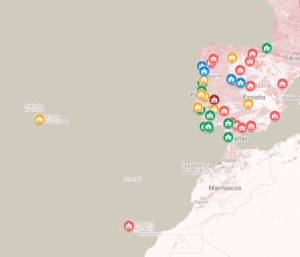
Fig. 6. Mapping of former conventual buildings located in the Iberian Peninsula (including Atlantic islands) that are currently in cultural use. Source: CONVENTUS Project.
From the intersection of these lines of research will emerge a “new perspective” on the history, architectural transformations, and role of this building in the urban development of Lagoa and in the lives of its communities over time, as well as its role as a hub for articulation and the sharing of networked museological experiences at the Iberian level, with a view to the development of future collaborative projects in the field of local architectural heritage.
Having started in October 2022, the project received the Municipal Excellence Award in the field of Culture in 2025, within the framework of the 3rd Social City Congress, and has already produced a significant set of results, including:
- the Project website;
- a Conversation Circle Series: four sessions held between March and April 2024. This activity sought to collect memories about the former Convent of São José from the local community;
- the International Seminar, “New perspectives on female monastic architecture and heritage”, held on 21–22 November 2024, in Lagoa, Portugal (Fig. 1). This event brought together a broad and diverse group of researchers, technical professionals, and students in the field of cultural heritage, with the aim of discussing the most recent approaches to the study of female conventual architecture and the challenges currently facing the management of this vast and rich heritage;
- a Collaborative Laboratory Series, held biweekly between January and February 2025. This activity was designed to collectively reflect on the conventual heritage under study, both in the present and with a view to the future (Fig. 7);
- the publication of the international book “Re-interpreting Female Conventual Heritage: Space, Memories and Reuse”, edited by Catarina Almeida Marado, Lorena Sancho Querol, María del Castillo García Romero, and Ismael Estevens Medeiros;
- the publication of a book dedicated to the building of the Convent of São José in Lagoa, edited by Catarina Almeida Marado, Lorena Sancho Querol, and Ismael Estevens Medeiros (in press).
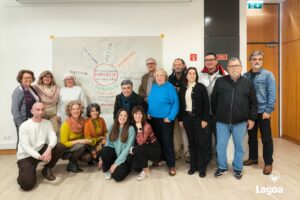
Fig. 7. Participants and outcome of Collaborative Laboratory 2 – Incubator of Affective Bonds in the Territory, held on 30 January 2025 at the Carlos do Carmo Auditorium in Lagoa.
By
Catarina Almeida Marado (PhD) / FRH member, Centre for Social Studies, University of Coimbra/ Portugal. CES-UC / CEAACP-Polo UALG / FCHS-UALG
https://ces.uc.pt/en/ces/pessoas/investigadoras-es/catarina-almeida-marado
Lorena Sancho Querol (PhD), Centre for Social Studies, University of Coimbra, Portugal.
https://www.ces.uc.pt/en/ces/pessoas/investigadoras-es/lorena-sancho-querol








Follow us: