



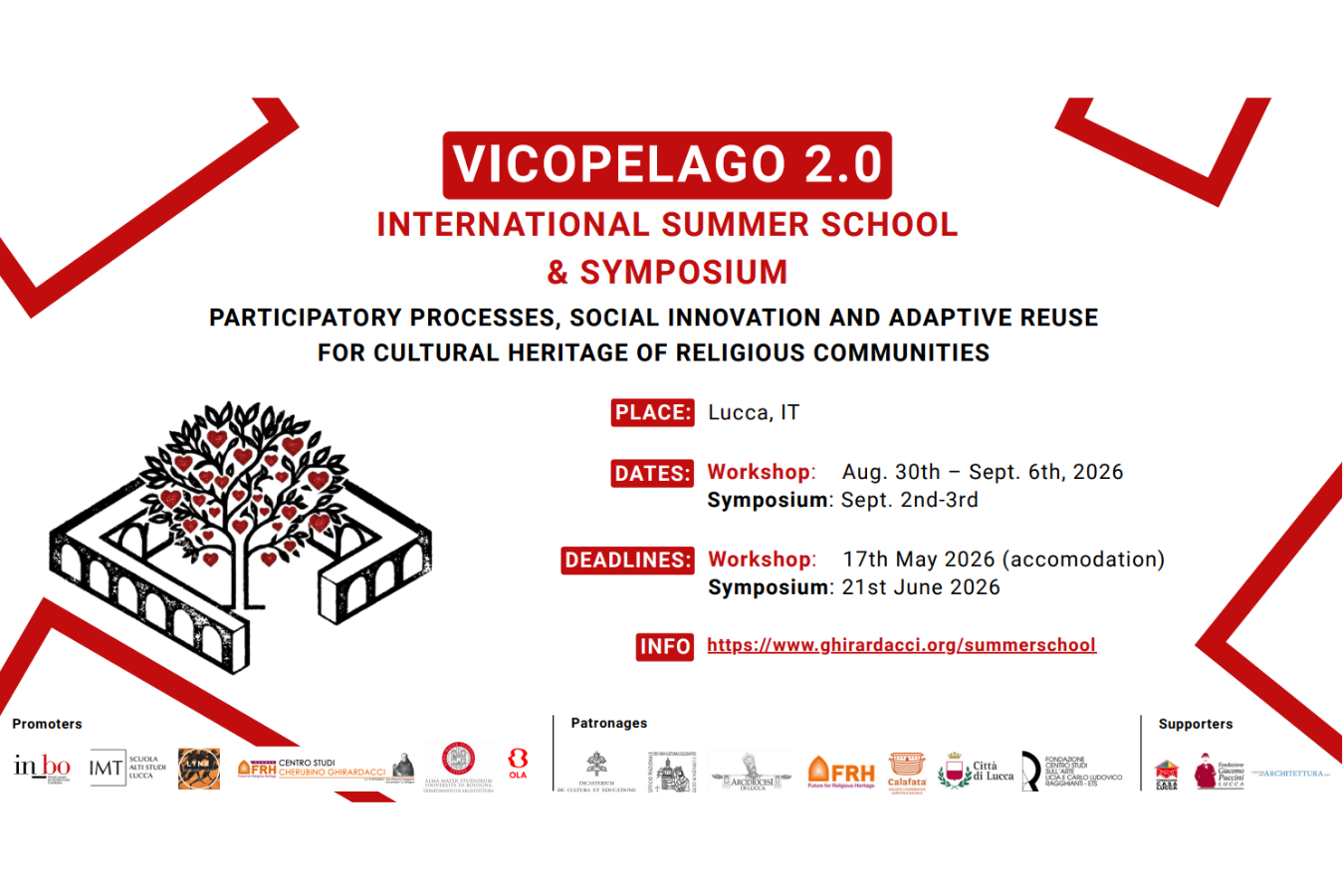
The West is facing a massive depopulation of religious orders, leaving behind vast, underutilised, or decommissioned real estate complexes across the territory. The closure and alienation of these assets represent an impoverishment for the local area and a concrete risk of dispersing significant tangible and intangible heritage.
Conversely, long-term sustainable enhancement pathways can preserve the original social and charismatic matrix of these complexes, transforming them into opportunities for cultural and social regeneration. Given their traditional scale, they could thus become “social lungs,” capable of addressing housing needs and conditions of social vulnerability.
How should we intervene in these complexes?
What techniques and processes can be adopted?
What legal frameworks apply to these assets?
The International Summer School aims to address these questions through two components:
- An educational workshop aimed at students, PhD candidates, and young researchers in the fields of Architecture, Engineering (Building and Management), Economics, Cultural Heritage, and Law. Participants will be guided in the design of adaptive reuse processes for the former Monastery of Sant’Agostino in Vicopelago (6 ECTS – CFU).
- A symposium, providing a forum for researchers, professionals, and experts in urban planning and policy to discuss ongoing processes, success stories, and emerging models or procedures for the enhancement of former ecclesiastical assets. The goal is to establish a “taxonomy” of reuse—an atlas of cases to support nascent processes and provide a practical tool for new projects.
The Summer School will take place from 30 August to 6 September 2026 in Lucca (Italy).
__________________________________________________________________________
How to participate
To participate in this summer school, you must:
- Phase 1. Read carefully all the information regarding this Summer School.
- Phase 2. Complete the pre-registration link (required to participate): https://forms.gle/bkteqGucVHYf5wHCA
- Phase 3. Register on the official University of Bologna website as soon as the dedicated page becomes available. (If you have completed the Pre-Registration Form, you will be automatically notified via email as soon as the official UNIBO registration portal opens).
Through this procedure, all participants attending the Summer School will be guaranteed a certificate of attendance and the corresponding 6 ECTS credits (CFU).
__________________________________________________________________________
Participation fee
The participation fee will be collected by the University of Bologna during Phase 3 (registration on the University website).
- Regular Fee: €140 (+ €10 University administrative charges).
IMPORTANT: 12 scholarships, reducing the enrollment fee to €90 (+ €10 University administrative charges), will be awarded to applicants demonstrating early interest in this Summer School, and specific interest in participatory design and in religious cultural heritage through their motivation letter and CV.
PLEASE NOTE: Accommodation is NOT included in the participation fee.
__________________________________________________________________________
More information
General information:
https://www.ghirardacci.org/_files/ugd/843b94_d203fcbb8a334b7fb06a401169dbf122.pdf
Workshop:
https://www.ghirardacci.org/_files/ugd/843b94_d203fcbb8a334b7fb06a401169dbf122.pdf
Simposyum:
https://www.ghirardacci.org/_files/ugd/843b94_9672d2e79e0048f5a5fadb1e8e84e959.pdf
Call for abstracts (Deadline: 21 June 2026)
The Social and Cultural Valorization of Built Heritage of Religious Communities. Policies and Processes in comparison” aims to discuss, at an international level, the policies, methods, and practices for reuse and refunctionalization of the houses of communities of consecrated life.
The Summer School invites proposals from designers, researchers, public administrators, and members of religious communities who have
direct experience with socio-cultural conversion processes involving former ecclesiastical properties.
Authors wishing to submit an abstract are invited to provide:
- An anonymous Word file (containing no references to the authors), including:
– The abstract in Italian or English (maximum 3,000 characters, including spaces);
– Title;
– Optional Bibliography
- A second Word file with a brief CV for each author (maximum 500 characters each);
(Optional) A maximum of 5 images, with a minimum resolution of 300 dpi.
All submitted proposals will undergo a review process by the Conference Scientific Committee and the FRH Scientific Committee. Authors of proposals deemed of particular significance will be invited to present in person during the Symposium. Authors of the contributions presented during the symposium will be invited to participate in a scientific publication project, envisioned as a reasoned atlas of reuse processes for underutilized or decommissioned properties of religious communities.








Follow us: