



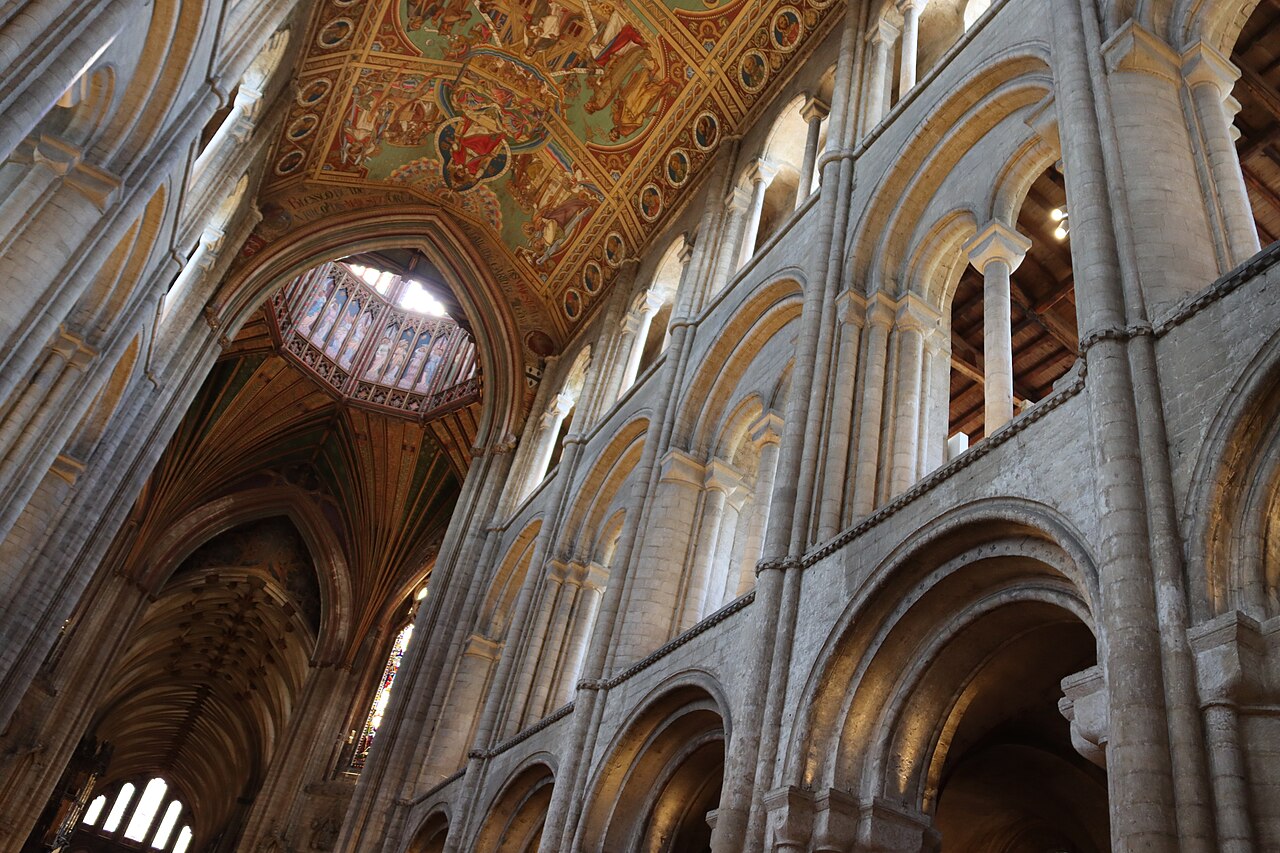
Ely Cathedral. Attribution: FrDr/Wikimedia Commons
The question of heritage, the changing use of religious sites, and the balance between religious and secular functions are becoming increasingly central in the field of religious heritage. Over the past two months, during my internship with Future for Religious Heritage (FRH), I have been able to explore this complex relationship firsthand. Working in the FRH office, I have contributed to research, membership outreach, and communications, while also gaining insight into heritage policy at a European level. This experience has been part of my Master’s degree in Religion and Heritage at the University of Groningen in the Netherlands, enhancing the course, which successfully blends academic theory with practical engagement, culminating in a thesis that addresses some of these pressing questions.
One of the most fascinating aspects of my studies and placement has been the dual role of religious buildings as places of worship and as heritage sites. A key marker of this distinction is the use of entrance fees. Paying to enter a religious space can feel like the ultimate sign of the heritagisation of a religious site, yet in today’s economic climate, it may be unavoidable. This raises critical questions about accessibility, inclusion, and the evolving role of cathedrals in contemporary society, issues that I plan to explore in my thesis. In this article, I will examine how different European countries approach entrance fees for religious sites, highlighting the various models in use and their implications for heritage and inclusion.
Entrance Fees in the UK: A Mixed Model
In the UK, entrance fees are a contentious issue, discussed even recently in the British press (see Henley, 2024; Grosvenor, 2024; Wright and Swerling, 2024). While all cathedrals allow free entry for prayer and services, access for tourists often comes at a cost. Approximately one in four cathedrals charge an entrance fee, with fees reaching nearly £30 at Westminster Abbey. Cathedral administrators argue that the cost of maintenance and upkeep, often running into tens of thousands of pounds per day, necessitates such charges. Ely claims it costs £10,000 a day to run, and St Paul’s says it costs them £10 million a year to keep open (Ely Cathedral website, 2025; St Paul’s Cathedral website, 2025).
Different cathedrals adopt different models to balance accessibility and financial sustainability. Ely Cathedral, for instance, charges £14 for adult entry but exempts local residents and parish pass holders. The cathedral’s website openly states that visitors are not required to pay if, “they are unable to, or do not wish to, pay to come in,” recognising the delicate balance between heritage funding and open access, particularly for the local community (Ely Cathedral website, 2025). Similarly, York Minster, which charges £20 for entry, waives fees for York residents and students from the University of York and York St John University, acknowledging the need to maintain a connection with the local community (York Minster website, 2025). St Paul’s in London approaches it slightly differently, and instead of focusing on the local community they offer discounts for family and group tickets, free entry for those with disabilities, and £1 tickets for UK visitors receiving benefits, and offer added benefits such as free guided tours and multimedia guides, access to the Dome Galleries, Crypt, and any art installations or special exhibitions (St Paul’s Cathedral website, 2025).
A 2012 report by Theos and the Grubb Institute, Spiritual Capital: The Present and Future of English Cathedrals, found that over a quarter of England’s adult population visited a cathedral within a 12-month period (Theos & Grubb Institute. 2012, page 10). These statistics highlight the cultural significance of cathedrals beyond their religious function, reinforcing the argument that they must remain financially viable while ensuring public access. At the same time, this reliance on tourism revenue raises concerns about the prioritisation of heritage over spiritual function. Are cathedrals becoming more like museums than places of worship? How does this shift affect the way both religious and non-religious visitors engage with these spaces?
France: A Stark Contrast
In contrast, France adopts a vastly different approach. It is effectively illegal for churches and cathedrals to charge entrance fees, a policy rooted in the separation of church and state, as the law of 1905 stipulates that centres of worship built before this date are for the “free, exclusive, and permanent” use of the Church (Guilani, 2017). This principle has sparked debate in light of the extensive restoration costs associated with Notre-Dame de Paris. Following the devastating 2019 fire, discussions briefly emerged about introducing an entrance fee to support reconstruction efforts. However, strong public opposition, including statements from church leaders emphasising the importance of free access, quickly quashed the idea.
Despite this policy, financial struggles remain a significant issue for religious heritage sites across France. Many smaller churches, particularly in rural areas, face closure due to lack of funding. Some heritage advocates argue that introducing limited entrance fees at major sites, such as Notre-Dame, could generate much-needed funds to support smaller, less-visited churches. France’s Culture Minister, Rachida Dati, suggested a plan which would charge tourists 5 euros, generating 75 million euros annually to help restore France’s crumbling religious buildings. She has said, “Across Europe, visitors pay to access the most remarkable religious sites. With 5 euros per visitor at Notre-Dame, we could save churches all over France. It would be a beautiful symbol,” (News Wires, 2024). However, this suggestion remains controversial, as it would fundamentally challenge the principle of universal free access to religious buildings in France.
Spain and Italy: A Complex Landscape
In Spain and Italy, the situation is more varied. While many religious sites remain free to enter, some major landmarks, such as Barcelona’s Sagrada Família and Milan’s Duomo, charge significant fees. The Sagrada Família, one of the most visited religious sites in the world, generated over €125 million from nearly 5 million visitors in 2023 (Sagrada Família annual report, 2023). This income is vital for the ongoing completion of Gaudí’s masterpiece but raises questions about accessibility.
Church law also plays a role in shaping policy in these predominantly Catholic countries. Catholic Canon 1221 states that “Entry to a church is to be free and gratuitous during the time of sacred celebrations.” This means that while access to churches during services must be free, tourist visits outside of service times may be subject to fees. This nuance allows for a range of approaches, from entirely free access in some locations to tiered ticketing systems in others. For example, Venice’s St Mark’s Basilica charges a modest €3 entry fee, while additional fees apply for special areas such as the bell tower and museum.
West vs. East: Changing Congregations
The Netherlands and Belgium offer a similar model but in a very different situation. With falling church attendance and many churches struggling to support themselves, different organisations have set up schemes to keep churches open to visitors and worshippers. Some cathedrals in the Netherlands and Belgium charge fees and others rely on donations, but in these countries, it is the smaller local churches that are most at risk. One initiative, Open Churches, seeks to ensure free public access to religious heritage sites while promoting their historical and cultural significance. This model fosters a greater sense of community ownership and engagement, encouraging voluntary contributions rather than mandated fees. Additionally, some Dutch and Belgian cathedrals operate hybrid models, charging for access to certain areas while keeping the main worship space free, such as the Church of Our Lady in Brugge, of which half is attached to the museum and half is free to enter.
This contrasts with parts of Eastern Europe and the Balkans, where large numbers attend Orthodox Christian churches, and the Christian share of the population has remained stable or even grown. Here it is uncommon to be charged for entry, even at major cathedrals in capital cities. These churches are typically maintained in a more traditional manner, primarily serving as places of worship. However, in regions experiencing a rise in tourism, such as Greece, a few churches or monasteries are beginning to introduce a small fee. The question arises: if churches can charge and people will still visit, will they? Do increased visitor numbers contribute to higher maintenance costs, or is upkeep more expensive when there is a drop in religious engagement, and the church can no longer rely on donations?
The Question of Inclusion
At the heart of this debate is the question of inclusion: Are cathedrals, historically open and welcoming, and a vehicle of conversion, now financially excluding certain visitors? Research into museum admission policies suggests that well-balanced pricing models, incorporating discounts and free access for specific groups, can mitigate exclusionary effects. The AIM: Admissions and Pricing Policy Report found that institutions can balance financial sustainability with accessibility by carefully structuring entrance fees (AIM. 2024, p.35-36). This research suggests that adopting the pricing models used by some UK cathedrals could be a potential approach to maintaining accessibility to religious spaces. However, since cathedrals and museums serve fundamentally different purposes, direct comparisons between them are challenging.
For my thesis, I will explore how entrance fees shape the dynamics between insiders and outsiders within cathedral spaces, with a particular focus on one cathedral in the UK. I will examine how these fees impact visitor experiences, whether they reinforce social divisions, and what alternative models might foster greater inclusivity. I also plan to conduct interviews with visitors and cathedral administrators to understand different perspectives on the issue.
Ultimately, my goal is to explore how we define heritage and inclusion in religious spaces. By examining the tensions between financial necessity and religious inclusivity, I hope to contribute to a broader discussion on the future of religious heritage in Europe. If cathedrals are both spiritual and historical landmarks, how can we ensure that they remain open to all, regardless of whether they arrive as pilgrims, tourists, or simply curious visitors?
Bibliography
AIM. Research into Admissions Pricing Policy in Museums and Its Impact. 2023. https://aim-museums.co.uk/wp-content/uploads/2024/11/AIM-Admissions-Pricing-Policy-Report-FINAL.pdf (Accessed 17/03/2025).
Giuliani, Emmanuelle. “Entrance Fees for Churches Would Be Unlawful, French Bishop Says.” La Croix International. https://international.la-croix.com/news/religion/entrance-fees-for-churches-would-be-unlawful-french-bishop/6335 (Accessed 17/03/2025).
Grosvenor, Bendor. “Where Is the Imagination Needed to Make Cathedrals Free for Everyone?” The Art Newspaper, December 13, 2024. https://www.theartnewspaper.com/2024/12/13/where-is-the-imagination-needed-to-make-cathedrals-free-for-everyone (Accessed 17/03/2025).
Henley, Jon. “Notre Dame Entrance Fee Sparks Opposition from French Catholic Church.” The Guardian, October 26, 2024. https://www.theguardian.com/world/2024/oct/26/notre-dame-entrance-fee-france-catholic-church-opposed (Accessed 17/03/2025).
News Wires. “French Culture Minister Proposes Entrance Fee for Notre Dame Cathedral.” France 24, October 24, 2024. https://www.france24.com/en/france/20241024-french-culture-minister-proposes-entrance-fee-for-notre-dame-cathedral (Accessed 17/03/2025).
Theos & Grubb Institute. Spiritual Capital: The Present and Future of English Cathedrals. London: Theos, 2012. https://www.theosthinktank.co.uk/cmsfiles/archive/files/Reports/Spiritual%20Capital%2064pp%20-%20FINAL.pdf (Accessed 17/03/2025).
Wright, Joe, and Gabriella Swerling. “Clergy Up in Arms as One in Four Cathedrals Charges Entry Fee.” The Telegraph, January 12, 2024. https://www.telegraph.co.uk/money/consumer-affairs/clergy-up-in-arms-one-in-four-cathedrals-charge-entry-fee/ (Accessed 17/03/2025).
“Free Cathedral Entry.” Ely Cathedral. https://www.elycathedral.org/plan-your-visit/visitor-tickets-and-tours/free-cathedral-entry (Accessed 17/03/2025).
“Ticket Types and Prices.” St Paul’s Cathedral. https://www.stpauls.co.uk/ticket-types-and-prices (Accessed 17/03/2025).
“La Sagrada Família Presents Its 2023 Annual Report.” Sagrada Família. https://sagradafamilia.org/en/-/la-sagrada-familia-presenta-la-memoria-anual-del-2023 (Accessed 17/03/2025).








Follow us: