



“Architectural conservation is something that embraces not just architecture in all its various forms, but a vast range of other subjects – environmental politics, urban planning, urban economics and tourism, and even war destructions and renewal […] Conservation is, and has always been, an integral part of modern society and its environment, like all the modern environments, did not just happened”.
(Miles Glendinning 2013)
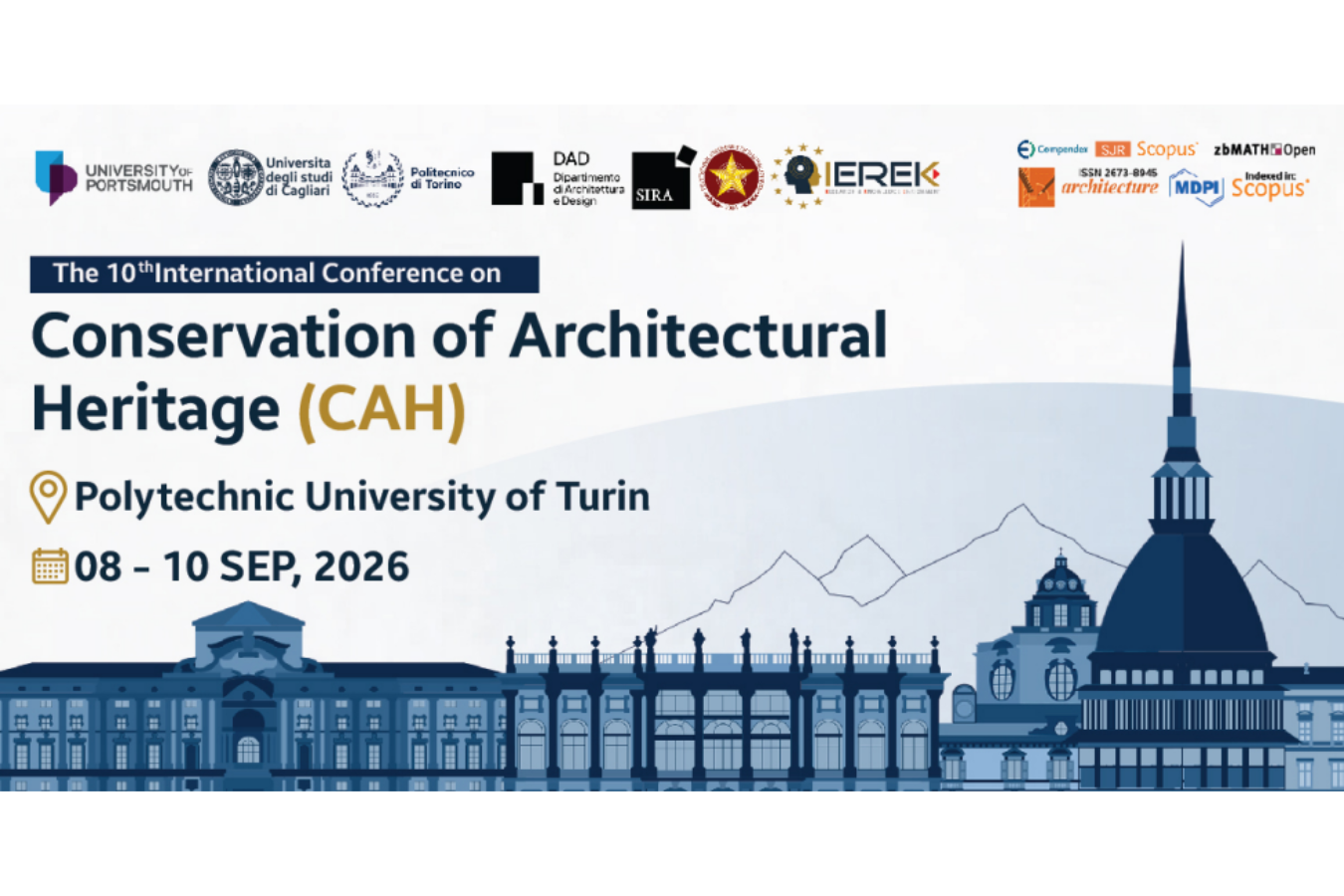
Starting from this concept, the 10th edition of the International Conference on “Conservation of Architectural Heritage” (CAH) aims at bringing together academics and professionals who care about heritage from different points of view and share their visions in protecting, preserving, and enhancing cultural heritage for the future. The conference has proven its success year by year, and this 10th edition, held in collaboration with the University of Portsmouth, the University of Cagliari, and the Polytechnic University of Turin, will stand out by discussing all the Art and Science of Heritage.
The conference will be held at the Polytechnic University of Turin, where magnificent history meets industrial reinvention and modernist experimentation. The city is a place where each era has inscribed its mark on the urban fabric like layers of a palimpsest. From its Roman foundations and Savoy palaces to its Liberty façades and pioneering industrial complexes, Turin embodies the coexistence of monumental power, artistic flourish, and working-class innovation. The city’s transformation of factories into cultural hubs, its stewardship of UNESCO-listed royal residences, and its ongoing debates around conserving modernist icons reveal heritage not as a static inheritance but as a dynamic field of negotiation. Hosting our conference here places us in a living laboratory of heritage, where conservation, adaptive reuse, and cultural identity are not abstract debates but visible realities shaping the city’s past, present, and future.
This year, the conference will have three special sessions:
- Modern Heritage Interpretation and Conservation. How do we preserve the heritage of modernity? This session examines the interpretation, analysis, and conservation of modern architecture, military sites, and industrial landscapes—heritage that is innovative, contested, and environmentally vulnerable, but still shaping our identities today. Join leading voices as we explore fresh approaches to interpretation, adaptive reuse, sustainable conservation, and community engagement, ensuring that the legacy of the 20th and 21st centuries is not only protected but celebrated and reimagined for the future. We will be rethinking narratives of modernity, addressing both material fragility and ecological pressures. By sharing case studies and forward-looking approaches, the session invites dialogue on how modern heritage can be protected, reimagined, and made relevant for future generations.
- Digital and Creative Heritage. In an era where technology is reshaping how we document, conserve, and experience cultural heritage, this session explores the transformative potential of digital and creative practices. From advanced documentation and conservation tools such as HBIM and 3D modelling, to immersive storytelling through film, media, augmented, and virtual reality, participants will engage with innovative approaches that bridge scholarship, practice, and public imagination. The session invites contributions that demonstrate how digital methods not only safeguard architectural heritage but also open new pathways for interpretation, accessibility, and community engagement. By showcasing pioneering projects and critical reflections, we aim to spark dialogue on how creative technologies can enrich conservation practice, democratize heritage knowledge, and foster deeper connections between people and place.
- Intersecting Perspectives on the Future of Religious Architectural Heritage: New Functions and Transformation Processes Quel avenir pour quelles églises? What Future for Which Churches? (Morisset, Noppen, Coomans, 2006). Twenty years ago, the authors of this well-known publication brought to public attention an issue that has since become a matter of significant concern and a priority on the agendas of church-owning bodies and institutions. This urgency was clearly reaffirmed by the 2018 Bishops’ Conference and further articulated through the subsequent drafting of the Guidelines on the Decommissioning and Ecclesiastical Reuse of Churches. This session aims to foster a broad and critical reflection on religious architectural heritage by exploring international approaches to church reuse, as addressed in Italy and in other countries. Through diverse perspectives and with the utmost openness to different religious confessions, the discussion seeks to assess ongoing transformation processes and emerging new functions for sacred buildings.
Selected papers of the conference will be published in a book series under the title of Advances in Science, Technology, & Innovation (ASTI) by Springer. Others will be published in the Resourceedings journal by IEREK Press. Best papers will have the opportunity to be published in the Architecture MDPI Journal under the Topical collection titled “The Conservation of Architectural and Urban Heritage: Sustainable and Creative Strategies”








Follow us: