


Across Europe, church buildings are undergoing profound transformations. Demographic change, declining congregations, and evolving social needs are some of the factors reshaping the role of sacred spaces within communities. While many churches face closure or underuse, they also offer significant potential for adaptive reuse, and raise important questions about heritage preservation, social functions, and the sustainability of religious buildings.
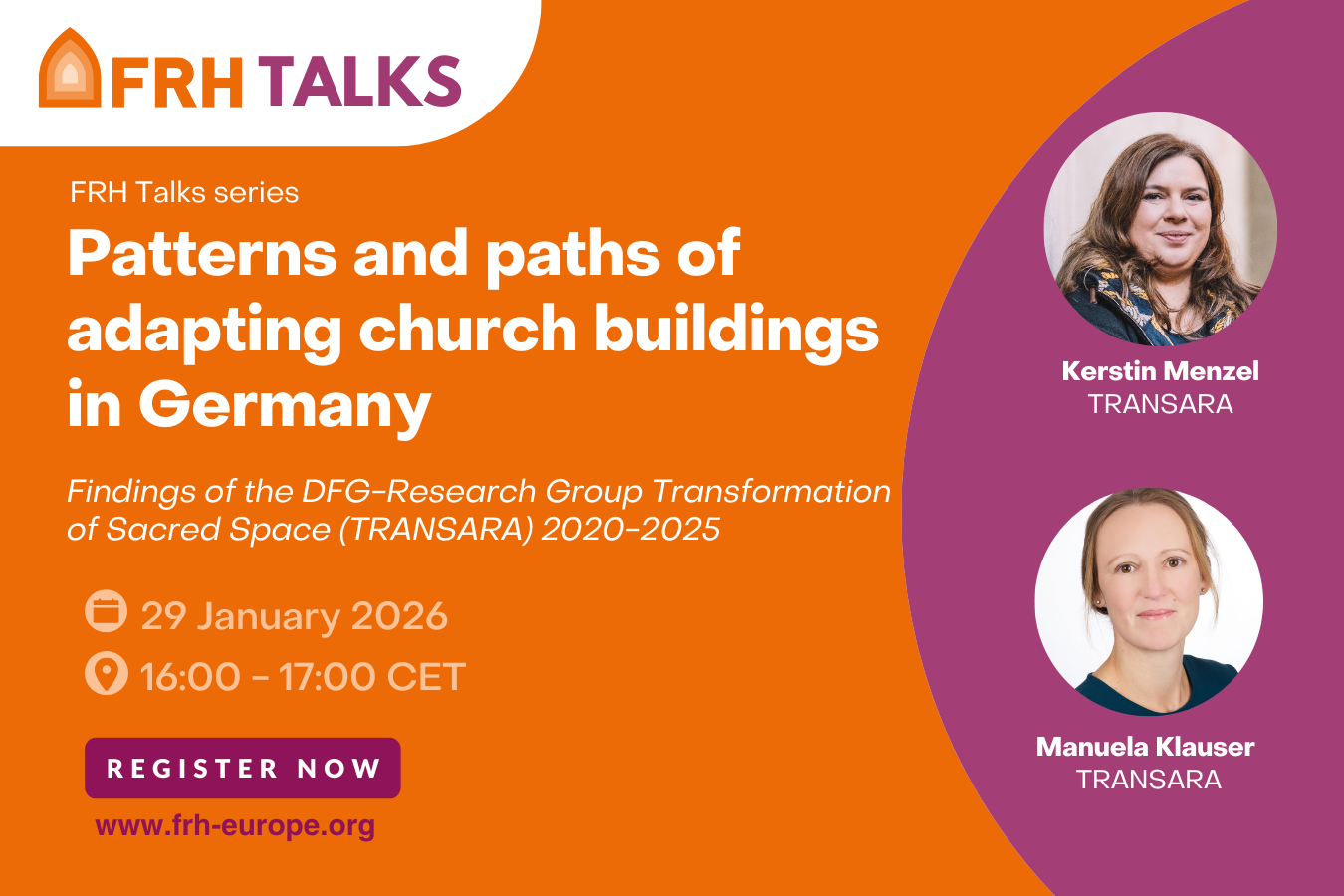
This FRH Talk focuses on patterns and paths of adapting church buildings in Germany, drawing on the findings of the DFG Research Group Transformation of Sacred Space (TRANSARA). The session will explore how churches are being reimagined, reused, or transformed, and which social, cultural, and institutional factors and challenges influence these processes. By presenting insights from a six-year research project (2020–2025), the talk will offer a comprehensive overview of current trends and emerging strategies across Germany.
The session will be led by Kerstin Menzel and Manuela Klauser, researchers at TRANSARA. Their work combines perspectives from spatial research, heritage studies, theological and social sciences, providing an interdisciplinary understanding of how the meaning and function of sacred spaces nowadays translates into practice.
The event will take place on 29 January 2026 from 16:00 – 17:00 CET. Join us for an afternoon to explore the transformation of church buildings and engage in the wider European discussion on the future of sacred heritage!
About the speakers
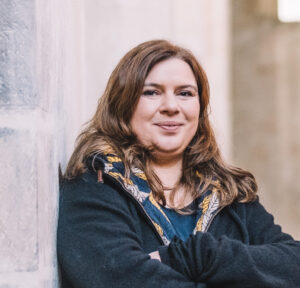 Kerstin Menzel
Orcid-ID 0009-0002-0577-3945
Dr. Kerstin Menzel is lecturer for Practical Theology at Leipzig University. 2024-2025 she was visiting professor of Practical Theology at Martin-Luther-University Halle-Wittenberg. Since 2020, she has been research associate in the DFG research unit FOR 2733 “Transformation of Sacred Space: Function and Use of Religious Places in Germany”, project 2: “Transformation of Sacred Space in a Secular Context”. Her research areas include processes of participation and appropriation in the adapted reuse of church buildings, cooperation of church and diakonia and the public dimension of liturgy.
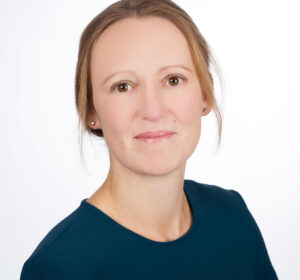 Manuela Klauser
Orcid-ID 0009-0009-1734-8576
Dr. Manuela Klauser is art historian with a doctorate and experienced in freelance project work. Since 2022, she has been research associate in the DFG research unit FOR 2733 “Transformation of Sacred Space: Function and Use of Religious Places in Germany”, project 1: Exemplary case studies on the transformation of sacred spaces in the Aachen area. Her research areas include architectural history of modern church buildings and their close connection to liturgical history as well as their link to architectural theory and architectural sociology.








Follow us: