


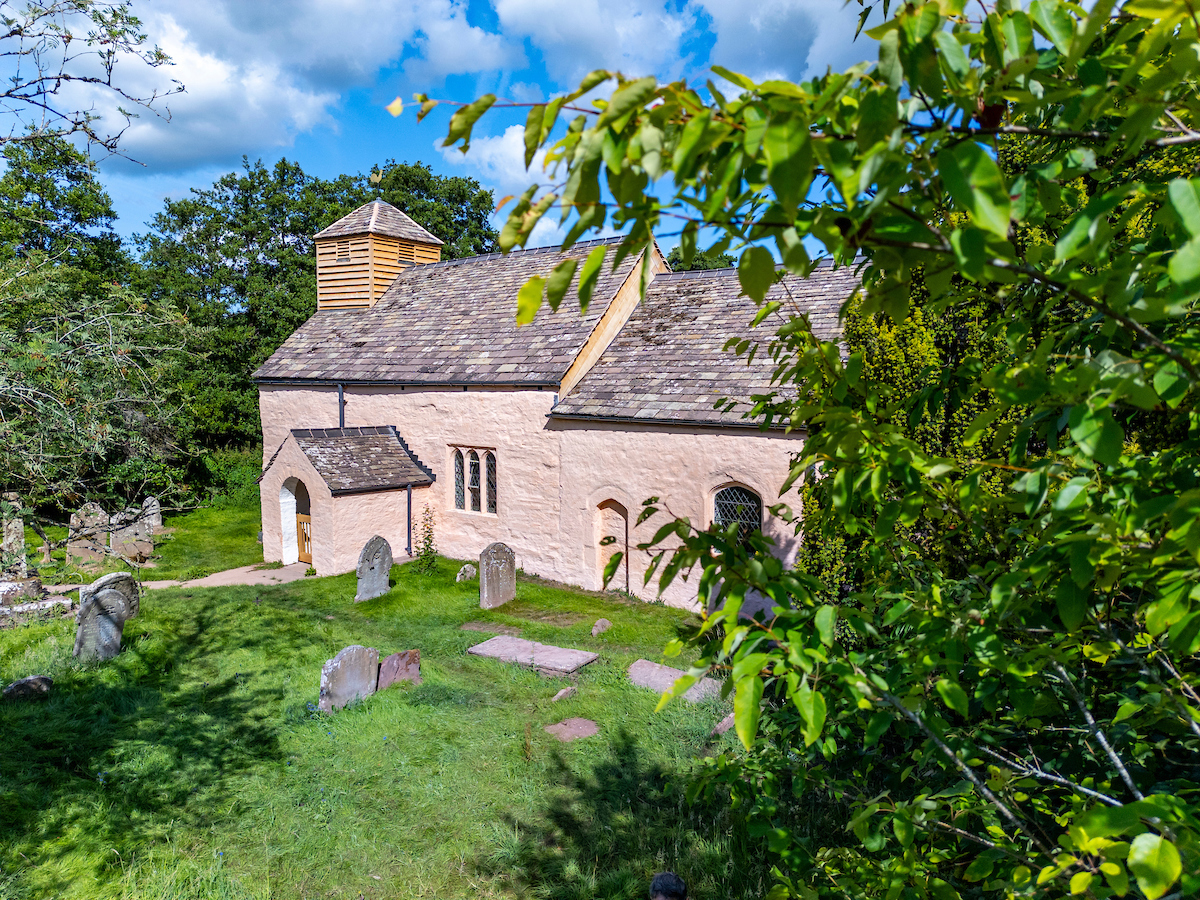
St James’s Church after its restoration. (C) Andy-Marshall
There’s something about St James’s, Llangua in Monmouthshire (United Kingdom). It gets under your skin. Maybe it’s the silver shimmer of the river as it winds along the church while sand-martins spiral over the banks. Or how the rubble sandstone walls bedded with lime and earth mortars enfold you.
I’ve been working to save St James’s for five years. Perhaps that’s why I feel so deeply protective of this little church. It really is no exaggeration that the roof was at the point of collapse before we started repairs. The contractors took their lives in their hands as they worked against the clock under the snapped structural timbers to install a web of scaffolding just to stop the roof from caving in.
But I’m getting ahead of myself.
The church that changed history
St James’s church, as it stands today, originated in the years after the Norman Conquest. The land was granted to Lyre Abbey, a foundation of the Benedictine order in Normandy, and the order established a small monastic cell to house a handful of monks.
The architectural remains tell us that this early church was a small stone building constructed using local materials. Some small windows cut high into the walls created a dimly-lit, atmospheric interior. The project archaeologist discovered two principal rafters of a 12th-century Romanesque roof truss that had been reused as a timber wall plate on the east gable of the chancel. In his words “a truly remarkable survival”.
In about 1500, the church was dramatically altered with new roofs and windows, and became a parish church. This medieval reconfiguring gives the church the character it has today — the most dominating feature of which are the 30 oak trusses which form the wagon roof. Intersecting oak ribs form the ceiling panels, which were then plastered. Our research has found that the oak used for the roof was well-managed and fast-grown; in the nave several of the wall plates are single lengths 13m long.
With the roof stripped bare, we could record the carpenters’ marks on the trusses. Three different types of marks were identified: “a race knife cut, forming a neat, hollow scrape; a scribe, forming a scrapped, rough mark, [and] a chisel, forming punched or cut indentations.” The three distinct marks suggest the trusses were made by three different carpenters.
Before the repairs began, the only clue that St James’s might have had a rood screen was the rebate in the south nave wall which may have given access to a rood loft. However, unequivocal evidence came when, while repairing the wall-heads, the contractors found fragments of delicately carved and pierced tracery dumped into the core of the walls.
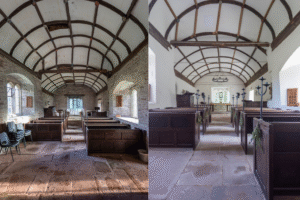
St James’s before (right photo) and after (left photo) completion of the restoration works. (C) Andy-Marshall
For the next 300 years, it seems like little happened to the church at Llangua — new windows were inserted into the south nave wall and at some point the roof covering changed from thatch to sandstone tiles.
In 1889 St James’s was restored by Thomas Nicholson of Hereford, who put new windows in the north nave wall and added a vestry. However, by the 1950s, the church was derelict: sagging under the weight of the roof, letting in water, overgrown and vandalised. In 1954 it was visited by Ivor Bulmer-Thomas.
This is where the story of our charity, the Friends of Friendless Churches starts.
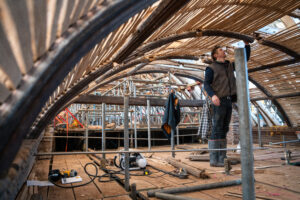
Works in progress at St James’s Church. (C) Lily Watts.
Ivor was then 49 but when he was in his early thirties, his young wife Dilys died shortly after giving birth to their first child. We will never know what it was about that little tumble-down church with its lop-sided bellcote that moved him, but we can be forever grateful.
In Dilys’s memory, Ivor restored the building. He hacked back the brambles, cleared the debris and repaired the medieval roof timbers. He mounted a black plaque with gold letters on the north wall. When you push open the door, it’s the first thing you see. It records, in Latin, that this church was restored in the memory of Dilys Thomas.
Less than three years later, Ivor founded the Friends of Friendless Churches. Ivor knew the power of church buildings — that even if they weren’t used or needed for regular worship, they were still potent places that were architecturally, historically, culturally important. This was especially true in the wake of the World Wars.
At a time when places of worship were being demolished, abandoned, or just neglected, Ivor was often their only defender. Through his tireless work, he affected changes in the laws regarding closed churches (Pastoral Measure, 1968) in England, and the formation of the New Mechanism in Wales. In his lifetime, he saved and helped hundreds of churches.
And it all started here at St James’s in Llangua.
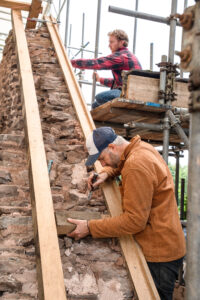
Works in progress at St James’s Church. (C) Lily Watts.
A heroic rescue
St James’s was declared redundant in 2020. It was no longer needed for regular worship. Given our charity’s connection to the place, we set about acquiring this church – to preserve it for the benefit of the nation as a place for curious visitors, weary walkers, or those seeking spiritual succour.
It took us almost five years to develop a programme of repairs, gain the necessary consents, raise sufficient funds, and to tender and complete the work. At times it felt like we would never make it, and that St James’s was destined for dereliction.
The building was in a parlous state. The stone tiles on the roof were too heavy for the medieval roof structure. Every single roof truss had fractured in at least one place. The wall plate had decayed, rotated and pushed out so much that in places it was no longer on the wall. It was a matter of time before the whole structure gave in.
In August of 2023, a funder finally saw the beauty and importance of this church. I will be forever grateful to the National Heritage Memorial Fund, the self-styled funder of last resort, for awarding us a grant which covered 74% of the total project costs. The remainder was raised from the Garfield Weston Foundation and donations from our very generous members and supporters.
Led by our project architect, Andrew Faulkner, the contract was competitively tendered and awarded to local traditional building company, Jones & Fraser.
After 13 months on site, St James’s looks very different. It’s taller, lighter, safer and… pink. Immediately, upon acquisition of the site, Jones & Fraser installed a series of props internally to hold up the cracked trusses. Then the full scaffold went up externally, and the stone tiles were carefully stripped and set aside for re-use. Using straps and props, the roof timbers, which had snapped, were lifted and squeezed back into an A-shape alignment.
The timber wall-plate, which was rotten in parts, was repaired and replaced as necessary. The stone wall-heads underneath these, which had been pushed and dislocated by the moving roof, were reset.
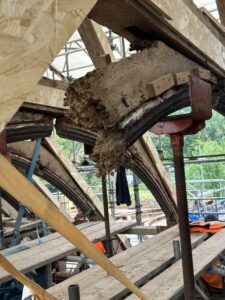
Works in progress at St James’s Church. (C) Lily Watts.
Stainless steel plates were bolted onto the trusses to increase their capacity to carry the weight of the tiles, and the timbers that could be salvaged were repaired using traditional joinery techniques. This included planing, by hand, metres of roll moulding, cutting new ribs, notching in new collars, and splicing new oak into old.
Believe it or not, back in its (almost) original shape, the roof is now 2ft higher than it was – it really had sagged and deflected that much.
When the roof was back in shape, riven oak laths were installed between the timber ribs. These were then plastered and limewashed – almost all of the complex timber repairs are hidden!
Internally and externally, all the cement pointing was raked out and the stonework was repointed in lime mortar. The walls were the plastered in lime. Inside, the walls were limewashed an off-white. Externally, we decided to go for a pale pink colour. This is intended to pick up tones of the orangey-pink in the local clay soil.
The stone mullions to the windows were repaired and one whole new mullion carved for the east window using Forest of Dean stone. This replaced a mullion of slathered cement.
Glazing repairs were completed on the windows where necessary.
Finally, the asbestos panels in the bell-cote were removed and the structure weather-boarded in oak. New louvre-boxes were created to given ventilation to the space. A stainless steel-frame had been installed to support the bell-cote at some stage in the 1900s. We had, however, pulled the roof back into a shape close to its original, medieval form – a form it hadn’t known for centuries. As such, the 1900s steel structure was no-longer in the correct alignment, and this had to be altered to fit the new roof shape.
A labour of love
This project was one of the most challenging and complex we have ever tackled. But it is also one of the most rewarding and one I will remember forever. I am forever grateful for the project team, whose skill and care, pride in their work and materials and generosity of spirit made this what it was.
By Rachel Morley, director of the Friends of Friendless Churches.








Follow us: